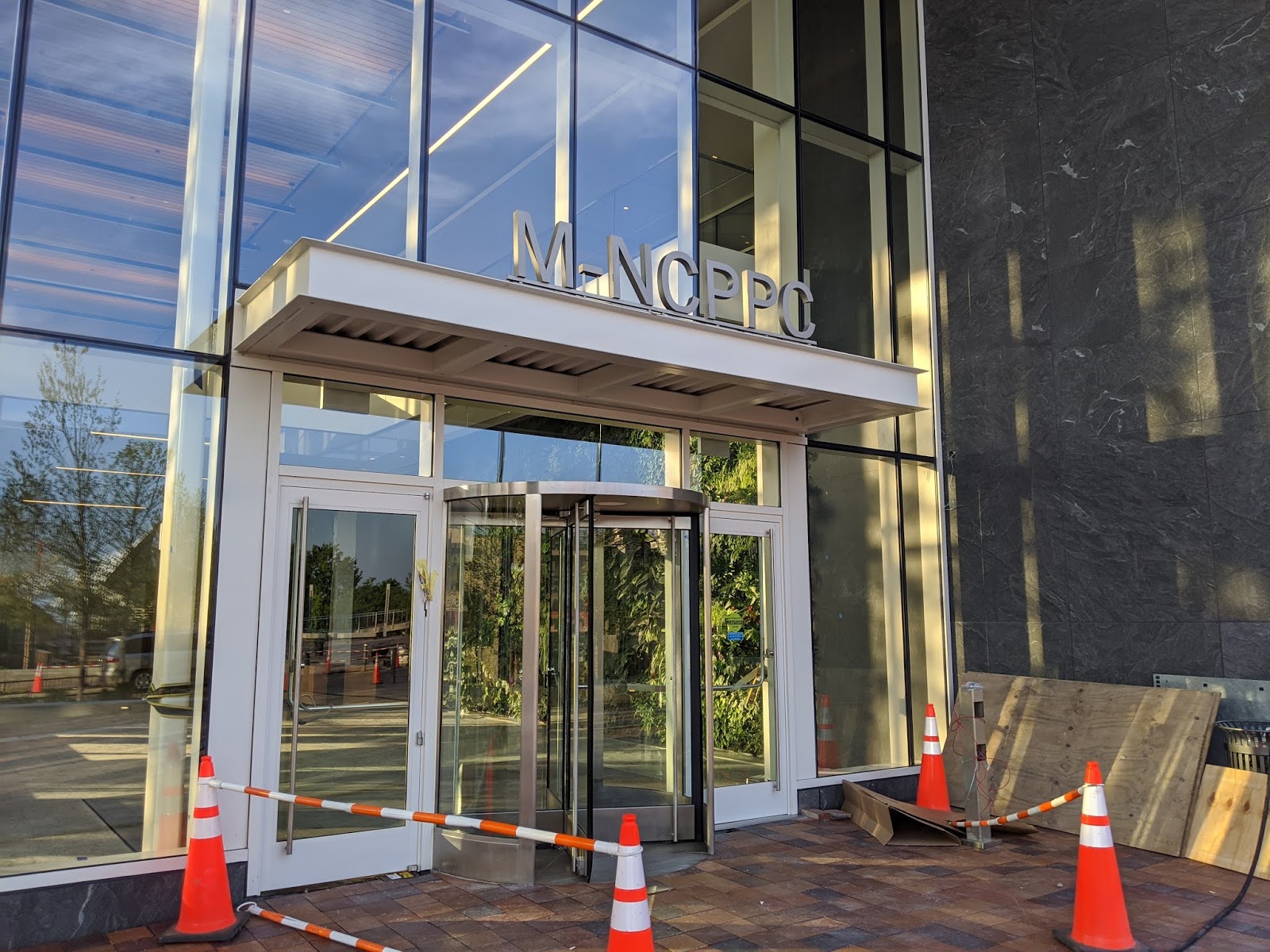
Showing posts with label Montgomery County Planning Board. Show all posts

Tuesday, March 17, 2026

Sam's Car Wash proposed for Damascus


Sam's Car Wash
could be coming soon to Damascus, if the local chain receives permission from the Montgomery County Planning Board. Yes, in anti-business Montgomery County, businesspeople apparently can't just open a car wash without jumping through Marxist government hoops. These hoops include a list of demands from government that sound like a cross between Soviet central planning and a mafia shakedown.

The car wash is proposed for 26203 Ridge Road (MD 27), currently the site of a bank building. Sam's would demolish most of the bank, but retain part of it for office space. Existing driveways would be consolidated into one two-way curb cut for ingress and egress. 


The proposed facility is a fully-automated express car wash with automatic gates and license plate readers. "A loader will guide the customer onto the conveyor" to enter the wash tunnel, the planning staff report says. Operating hours would be 7:30 AM to 7:30 PM Monday through Saturday, and 8:00 AM to 6:00 PM on Sundays. 


Planning commissioners will review the conditional use request at their Thursday, March 26, 2026 meeting. Staff are recommending approval of the car wash with a massive list of conditions, including the County restricting the hours of operation to the aforementioned schedule, a stipulation that no more than 4 employees may be on-site at any time, forcing the company to enter a "surety and maintenance agreement" with the Planning Board in order to receive a building permit, and forcing the company to pay the County for the full cost of constructing an 8' bike lane, a 6' street buffer, and a 2' widening of the existing sidewalk. 

And we wonder why the Montgomery County economy is moribund!

Saturday, May 24, 2025

Transformer explosion a symptom of corrupt Montgomery County planning policy


KABOOM! Another Pepco electrical transformer exploded yesterday afternoon in downtown Bethesda's Woodmont Triangle, cutting off power to many residents and businesses in the area. This has become an unacceptably-regular occurrance downtown. Importantly, power grid issues have become frequent in the two areas of Bethesda that were upzoned since 2016, downtown Bethesda and Westbard, since those sector plans were passed. This is no coincidence, and is a clear example of what many opponents of those plans warned - that the growth allowed would outstrip the capacity of the local infrastructure, including utilities. Such gross negligence has impacted communities countywide, where County officials have failed to deliver even the new infrastructure that was included in sector plans, such as downtown Bethesda, Clarksburg, Damascus, Wheaton, Glenmont, and Watkins Mill.

Around 3:00 PM Friday, a massive explosion was heard - and seen - in front of 7944 Norfolk Avenue in Bethesda. One witness saw a bright flash, and noted that power lines on nearby blocks were shaking. The explosion was so big that Montgomery County Fire and Rescue Services were dispatched to the scene, but according to witnesses, departed after finding no ongoing fire. Another nearby resident told me that the lights in their apartment blinked, but power remained on. Many others were not so lucky, as you can see in the Pepco outage map shown here.


In the close vicinity of the transformer explosion, the power outage darkened buildings along the north side of Cordell Avenue, and in the 7900 block of Norfolk Avenue. Those were only two of the affected streets. Not only was this an inconvenience for many residents in an age where everything - including working-from-home - relies upon Wi-Fi, but was a cost to the bottom line of business owners in the area, as well.

Along with frequent power outages and transformer explosions in downtown Bethesda, where thousands of new residential units have been approved and constructed under the 2017 Bethesda Downtown sector plan, the Westbard area has been impacted by ongoing brownouts and power outages. The latter began in 2017, which coincided with the redevelopment of the "Westwood Complex" properties that was approved a year earlier, in the Westbard sector plan.


During these sector plan processes, many residents expressed concerns about how the area's aging power grid, and water and sewage systems, would handle the addition of hundreds or thousands of new households. And if they, inevitably and logically, could not, who would pay for the eventually-necessary upgrades? Their concerns were laughed off by the Montgomery County Planning Department, County Planning Board, and County Council. Nobody living or running a business in the affected areas is laughing anymore.

We've also seen increased flooding during heavy rains in downtown Bethesda, Westbard, and White Flint, which County officials have tried to blame on "climate change." In fact, it is those very Planning staff members, Planning Commissioners, and County Councilmembers who are personally responsible for the flooding - which has been fatal, in some tragic cases - because they approved the massive development and reduction of green space that has increased runoff countywide.

All of these problems stem not simply from developer greed, but from County government not placing limits and protections on that greed in the planning process. You can't blame developers for seeking the moon, if they can get it - that's their job. It is the planners, Planning Commissioners, and County Councilmembers who are tasked with protecting their constituents.

Instead, we've seen planners and commissioners who represent development interests fully take over the planning process. And developers in the Montgomery County cartel have controlled a majority of County Council seats since 2002, when they funded the "End Gridlock" slate. Today, we have a Council where all 11 members have taken varying degrees of money from developers. Not surprisingly, the Council's planning agenda has mirrored that of the developers who funded their victorious campaigns.

The approach can be summed up with a childish analogy. Developers - and the elected, appointed, and hired officials they support above and below the table - are skipping the vegetables, and going right to the chocolate cake every time. That all-sweets diet has understandably impacted the health and quality of life in our communities. Instead of doing the hard work of providing the infrastructure for the growth being proposed, our officials are simply approving all the growth, and not requiring those who are profiting from that growth to fund the infrastructure upgrades it requires.

Longtime residents know that developer-beholden officials have been a major factor in the economic, environmental, and quality-of-life decline over the first quarter of this century. Those engaged enough to pay attention can keep complaining about it - or we can actually do something about it. Here are just a few action items to consider:

1. Virtually every town, city, and county has an adequate public facilities ordinance. Montgomery County's is clearly in-adequate. It needs to be beefed up considerably. An APFO doesn't limit growth, it simply ensures that the private companies profiting from that growth pick up the tab for the infrastructure their new development demands: electric grid and sewer capacity upgrades, new classrooms, new social services, new police and fire facilities and equipment, etc. Right now, the majority of those costs - like the taxes the Council increasingly exempts developers from - are being pushed off onto the backs of residents in the form of higher property taxes and higher utility bills.

2. Stop the planning-to-profit revolving door. The Council should pass a law preventing planning staff and commissioners from accepting jobs with development companies and real estate law firms for at least 5 years after leaving their County position. 

3. Vote smarter. Do you vote somebody else's ballot on Election Day, a ballot that represents someone else's interests, instead of your own? Think about it. The rotten Apple Ballot represents the interests of the powerful teacher's union, which along with developers and other cartel members, is bankrupting the County finances. Endorsements by The Washington Post editorial board reflect the interests of developers, who not only purchase massive amounts of ads in the Post every week, but have actually bought multiple properties from the Post itself, which has profited from those real estate transactions. The Post, in effect, is engaged in property development itself.

Instead, vote YOUR ballot, that represents YOUR interests. The interests of you, your children and grandchildren, your neighborhood, your business. 

Do your research. Find out which candidates are funded by developers, and pay attention to which candidates are calling for responsible growth, and which are calling for unlimited growth unsupported by new infrastructure. The developer-funded candidates can often be identified by their use of terms like "abundance," "housing now," "missing middle," "inclusionary zoning," "redlining," "attainable housing," "social justice," "activity centers," "resilience," "growth corridors," "mix of housing," "Thrive 2050," "a variety of housing types," "equity," "duplexes," "triplexes," "quadplexes," and "parking minimums." That final phrase is utilized in calling for those parking minimums to be done away with to expand developer profits, not the enforcement of such adequate parking space requirements.

Remember, the County Council not only determines who sits on the Planning Board, but also controls the budget of the Planning Department. So, while it cannot regulate who is hired by the department or the policies it puts in front of the Board for approval, it can defund the Planning Department if it pushes policies that are contrary to the public interest.

4. Public financing reform. Currently, developer contributions to those Council candidates using the County's "public" financing system get matched by you, the taxpayer. Does that sound fair to you?

Corrupt users and supporters of the current "public" financing system will tout the "small contributions" that are fueling their campaigns with "people power." What they won't tell you, is that a massive number of those "small contributions" are coming from developers, development attorneys, and their family members. This is a huge advantage, as those candidates can take a great haul in checks from those development interests, and then they receive a matching amount from the pot of taxpayer money that has been budgeted for "public" financing.

Real public financing not only would not allow such outsize developer involvement, but would give every participating candidate at least some respectable amount of money to campaign with, instead of rewarding corrupt candidates who are backed by deep-pocketed development interests with six-figure payouts from the taxpayer. The current system represents a brilliant move by developers and their puppet candidates to force you to fund their campaigns.

Tuesday, April 8, 2025

Montgomery County's highway robbery


The Montgomery County Planning Board is on the verge of sending the County Council a draft of the latest Master Plan of Highways and Transitways (soon to be called the Master Plan of Walkways and Bikeways, if planners get any more woke) that will do many terrible things, chief among which is permanently removing any chance of building the long-delayed M-83 MidCounty Highway Extended from Montgomery Village Avenue to Clarksburg. If approved by the Board at its meeting this Thursday, April 10, and the Council at a later date, it will be the realization of a long-held fever dream by the War-on-Cars folks who suffer from Highway Derangement Syndrome, virtually all of whom have motored to their Kill M-83 meetings in the very cars they claim you need to get out of. It will also be a theft and reckless disposal of one of the most valuable public holdings government can possess: a transportation right-of-way.

Passage of this Master Plan will drive the stake through the heart of M-83, and confirm that once again County officials were lying through their teeth when they promised all stakeholders and residents of the Upcounty that they would deliver the infrastructure needed to support the massive housing development they had proposed for rural Clarksburg and Damascus. As we all know, all of the new housing was approved and constructed. But none of the supporting elements were. 

No M-83 Highway. No Corridor Cities Transitway light rail. And no high-wage jobs. All of these items were mandatory, but the Council didn't deliver a single one.

Now the Council is poised to throw away something that, frankly, is not theirs to discard. The highway project, and its right-of-way, belong to the taxpayers of Montgomery County. Planners are giddy to note in the Master Plan materials online that the County may not only remove the highway from the plan, but give the land away for free to the Councilmembers' developer sugar daddies. They've done this many times before, giving away public rights-of-way to developers via a "Declaration of No Further Need" abandonment.

A right-of-way is simply too valuable to waste. The Council is free to go down in history as the deranged and corrupt elected officials responsible for worsening traffic congestion, increased emissions from cars idling in traffic jams, and increased response times for police and fire calls by canceling an essential highway. It won't be the first time, as the Council already canceled the equally-long-planned new Potomac River crossing, the Northwest Freeway, the North Central Freeway, the Rockville Freeway, the Montrose Parkway East, and the Northern Parkway.

But a right-of-way is not theirs to give away. They have a responsibility to preserve it in total. No one can predict the needs of the future. Whether it is a road, or a railway, or some form of transportation or use we haven't even imagined yet, these are the scenarios for which smart governments obtain rights-of-way at great cost. Believe it or not, Montgomery County long ago had smart government.

This Master Plan draft represents a double betrayal of the public trust, first and foremost the trust of residents in Clarksburg, Damascus, and Goshen. People bought houses in Clarksburg and Damascus with the expectation of the M-83 and CCT providing viable options for commuting to the Shady Grove Metro station and beyond. Only to find the Planning Board and County Council pulling the rug out from under them after they had taken on their mortgage, and paid all the hefty fees and taxes to the County. But it is also the latest betrayal by the Council of one of its chief charges, stewardship of County assets and resources, which include planned highways and expensively-obtained rights-of-way. Canceling the M-83 is, quite simply, highway robbery.

Wednesday, March 29, 2023

Montgomery County Council unanimously "reaffirms" appointment of James Hedrick to Planning Board


Montgomery County Planning Board commissioner James Hedrick will remain a member of the body, after his February appointment was unanimously "reaffirmed" by the County Council yesterday. County Executive Marc Elrich had vetoed Hedrick's appointment last Friday, leaving the Rockville resident's fate in limbo for several days, as supporters and detractors resumed their debate over his candidacy over the weekend. Hedrick had received eight votes from the eleven-member Council on February 28 to secure his appointment, and needed nine yesterday to survive Elrich's veto.

Hedrick found nine, and then some, when every councilmember supported his appointment at yesterday's Council session. Some councilmembers who showed unusual spine in opposing Council President Evan Glass's behind-the-scenes maneuvering when the new Council first convened last December found their knees buckling on Tuesday. A tweet prior to the meeting inadvertently revealed that the Council had already reached a decison to unanimously support Hedrick, an agreement that was come to off-the-record, out of public view. Some of the same councilmembers who took Glass to task for making decisions off-line in December about committee assignments went along with his ex parte process this time.

It's likely the Council circled the wagons in this case because Glass could have sold the Hedrick Holdouts the argument that this was a vote on principle, of the power and will of the Council versus the executive. Does this mean the more independent minds on the Council will now support the Glass agenda for the rest of his term as president? No, as the competing bills on rent stabilization clearly show.

Is the Hedrick appointment reason for opponents of Thrive 2050 and its threat to end single-family-home zoning to get their blood pressure up? No. As I noted Saturday, Hedrick's support of Thrive and upzoning are hardly unique on the new Planning Board. The Council will not appoint anyone who opposes Thrive. Hedrick's votes will likely be indistinguishable from any other commissioner this Council would have appointed in his place.

If anything, Hedrick's appointment may improve the quality of the Board's work. Even if you disagree with the plans and policies he might vote to approve, his experience as chair of Rockville Housing Enterprises gives him an expertise on some of the technical and practical issues of multifamily housing that has been lacking in some of the commissioners in recent years. Board observers won't soon forget the many classic "amateur hour" moments from the Casey Anderson era, such as commissioners determining the maximum height for a parcel in the Westbard sector by looking at a distorted Google Street View image during a meeting.

One thing is for certain: the Hedrick controversy aside, the developer campaign contributors to the County Council are over-the-moon about the Planning Board situation as a whole. By all rights, the many scandals that ended with the forced resignation of the entire Board last year should have triggered comprehensive investigations by the local media, the Council, the Maryland Attorney General, and the FBI - starting with Farm Road and ending with Liquorgate. Some people might have even been looking at time behind bars in federal prison. Few could have imagined that the Council would be able to not only entirely sidestep investigations, but also seize the unprecedented power to appoint an entirely new Board and Chair all at once. 

We can wonder why the media and those other levels of law enforcement agreed to look the other way, much as they did during the 2018 County government $6 million embezzlement scandal. But we can truly know why the Council found the chutzpah to sweep the Anderson-era scandals under the filthy Maryland-National Capital Park and Planning Commission rug. 

Once again, it goes back to one of the most pivotal moments in Montgomery County political history: the victory of the County political cartel over the Columbia Country Club in the Purple Line struggle. The elected officials dared to grab the third rail (pun intended), and when the next election came around, they realized that they weren't electrocuted - they were reelected! Turns out, especially when you have the local media in your back pocket, the third rail is a brass ring. If we can beat the Columbia Country Club, they concluded, we can beat anybody.

Energized to try their luck, the 2014-2018 Council approved a massive property tax hike, and the Westbard sector plan. They even aggressively defended the cover-up around, and ongoing desecration of, the Moses African Cemetery in Bethesda. While they ended up getting term limits, albeit with extremely-generous 12-year terms, when the actual elections came around in 2018...the voters - whose posteriors were still smarting from a tax and Westbard spanking they had just received two years prior - voted for the same or similar candidates who had delivered the beatdown to them.

The Council couldn't believe its good fortune. Realizing it now enjoyed serious Trump-shooting-somebody-on-Fifth-Avenue immunity, it could now go for broke. "Smart growth" around transit stations and the 2014 pledge that "we just want the shopping centers, we won't touch the neighborhoods" suddenly gave way to developer fever dreams like Thrive 2050. Serious players like Kenwood and the Citizens Coordinating Committee on Friendship Heights who had to be bargained with in the past could now be ignored, resulting in decisions like the Little Falls Parkway road diet scandal, and the Westbard-area road closure fiasco.

Of course, the Anderson-era Planning Board was the harbinger of this iron-fist, winner-take-all era we've now entered. Gone are the days when well-argued testimony from a resident could lead a commissioner like Francoise Carrier, Amy Presley or Norman Dreyfuss to change their mind on an issue. When you come to a Planning Board session in recent years, you know how the vote is going to go, with extremely rare exceptions. Your only role as a resident or civic association officer is to at least get the opposing view on the record for posterity.

One can hope independent minds will somehow emerge on the new Planning Board. But the Council demonstrated such closed minds in its interview process, that it's hard to believe this new Board won't redefine the term "lockstep" with frequent unanimous votes. 

Consider that among the applicants for the interim board was former Rockville Mayor Larry Giammo. By every measure, Giammo was - if anything - overqualified to serve as a Planning Board commissioner. As mayor, Giammo successfully delivered the $400 million revitalization of Rockville Town Center. He also had served as a commissioner on the Rockville Planning Commission prior to that. And after leaving office, he has been a leading voice for the interests of City residents on growth, development and school overcrowding issues. In short, someone familiar with the nuts-and-bolts of development and its impact on public facilities and infrastructure, but with a record of representing the best interests of the community. That is the essence of what you would want in a Planning Board commissioner, right?

The Council didn't even include Giammo on its finalist interview list. 

That tells you everything you need to know about the credibility of the County Council in this process.

Saturday, March 25, 2023

Montgomery County Executive vetoes County Council appointment of James Hedrick to Planning Board

James Hedrick

Montgomery County Executive Marc Elrich (D) has vetoed the appointment of Rockville resident James Hedrick to the County Planning Board. Elrich has not made the reasons for his disapproval of Hedrick public yet. The only public statement regarding the matter came in response to Elrich's move, a press release from County Council President Evan Glass (D).

“I am disappointed that County Executive Elrich disapproved James Hedrick’s appointment to the Montgomery County Planning Board," Glass wrote in his statement. "Mr. Hedrick received affirmative votes from a supermajority of councilmembers to become a Planning Board member on Feb. 28."

While Hedrick received a supermajority of eight votes from the eleven member Council that day, he will need at least one more if the Council is to override Elrich's veto and be appointed to the Board. Glass wrote that the Council will "discuss" the veto at its next meeting this coming Tuesday, March 28, 2023. 

Hedrick was a candidate for the Rockville City Council in 2019. He currently serves as the chair of Rockville Housing Enterprises (his term expires June 1), and as the vice-president of Action Committee for Transit.

Wednesday, January 11, 2023

Boyds Warrior Canine Connection HQ proposal to be reviewed by Planning Board


A proposal to create an operational headquarters for the non-profit Warrior Canine Connection in Boyds will be reviewed by the Montgomery County Planning Board. The plan proposes to convert an existing barn and kennel facility at 14934 Schaeffer Road into a headquarters with office space for the organization. All 17 acres of the property, which are located within Seneca Creek State Park, are owned by the Maryland Department of Natural Resources. That means that the plan will be review under the mandatory referral process. In plain English, that means that the Board may comment, advise and recommend changes to the proposal, but has no legal authority to force the DNR to alter the plan, or to deny approval of the plan.

Warrior Canine Connection plans to use the modified building to expand its program and the number of physically and mentally-injured veterans it can assist. Through the organization, veterans train service dogs for other veterans. The new headquarters facility will have additional space for the breeding, training and care of the dogs housed by the non-profit for the program.

Because the property is on a rustic road, no modifications are required to the front entrance of the site. The entrance driveway will be fully-paved, a new well and septic tanks will be installed, new pathways will be paved, an ADA-compliant parking area will be created, an above-ground fire suppression tank will be erected, a paved area for dumpsters will be poured, and power lines will be undergrounded. No new outdoor lighting is being sought by the applicant. There will be one employee on-site 24 hours a day in case of any emergency related to the property or to the animals. 

The Board will review the proposal at its January 19, 2023 meeting, where the public may testify. Planning staff are recommending approval of the application.

Rendering courtesy Montgomery County Planning Department

Tuesday, December 13, 2022

Montgomery County Council has forfeited its privilege to "power" over land-use and zoning authority structure


Montgomery County Councilmembers who call the attempt to examine the county's current structure of land-use authority "a power grab" are implicitly acknowledging they have been wielding that power through the current Maryland-National Capital Park and Planning Commission structure. The disastrous results of the Council's exercise of that power speak for themselves. Their hand-picked five members of the Montgomery County Planning Board were forced to resign this fall, under accusations of consuming alcohol in their County office building and pressuring others to do so, creating a "toxic misogynistic and hostile workplace," repeated violations of the Open Meetings act, letting individual commissioners' grievances implode the board, and engaging in staff firings as retribution. Those five people, in the Council's judgement, were the five best who had applied. That says as much about the Council as about the disgraced commissioners themselves.

Those issues that led to a regional embarrassment for the County this fall were hardly the only ones to stain the Planning Board and County Council. The Board and Council have routinely passed master and sector plans over the outspoken objections of the communities the plans will guide growth policy and zoning in.

Thrive 2050 was only the most recent example, a "blow-up-single-family-home neighborhoods" plan and developer fever dream the Council rubber-stamped into law mere days after declaring that it had "no confidence" in the five commissioners who drafted and approved every word of it. Virtually all of the support for Thrive 2050 came from people who do not actually live in the single-family home neighborhoods the plan would bulldoze, developers, and Astro-turf "YIMBY" activists. The plan itself was neither novel nor innovative, but a hodgepodge document plagiarized from the few other jurisdictions around the country corrupt and crazy enough to end the single-family home zoning most consider to be the American Dream. Other than generating more developer profits, those earlier Thrive-style efforts elsewhere have failed to realize any of the false promises their advocates had touted.

M-NCPPC, the Planning Department and Planning Board have a horrific record on racial bias, particularly with the African-American community. The most prominent examples of this have been the Farm Road scandal, the desecration and attempted cover-up of the Moses African Cemetery in Bethesda, and the repeated calling of multiple armed police officers to silence or remove African-American protesters at Planning Board meetings. The Council had full knowledge of those events, and never exercised their self-proclaimed "power" to criticize, investigate or remove any employee, commissioner or chair involved in those well-documented racist actions. Not even after the summer of Black Lives Matter in 2020 did the Council revisit these transgressions.

Now that County Executive Marc Elrich and State Senator Ben Kramer are attempting to formulate a process to examine a reform or replacement of the current land-use authority structure, the Council is attempting to end the discussion before it starts. It's too late for that, because residents affected by the land-use decisions made over the last two decades have already been discussing it. That discussion has led to increasing calls to rein in M-NCPPC and the Montgomery County Housing Opportunities Commission. It's time to have this conversation, and explore the options.

Much like the County's outdated government monopoly on the sale of alcohol, the M-NCPPC is a highly-unusual arrangement for a land-use authority. It includes Montgomery and Prince George's County, two jurisdictions that just happen to have had many development-related scandals and outsized developer influence over the years. Those scandals - topped off last week by new questions about the ousted Planning Board's 2021 purchase of parcels in downtown Bethesda for $9.6 million for a park that now won't be built - have led us to the point that we need to look at how to make land-use decisions more accountable to all stakeholders, not just to those with the most money and power. 

The proposed commission, representing cooperation between county and state leaders, is a good starting point for this discussion. It's clear that those who have wielded the "power" in land-use and zoning decisions have abused that power, shown major errors in judgement, and failed to exercise their oversight role responsibly. They've lost their unearned privilege to continue to hold that power. 

Reforming the land-use authority structure could well mean transferring that power to others. It could also mean pulling Montgomery County out of the M-NCPPC. It should also mean restoring the Office of the People's Council and sector plan committees, and the creation of Advisory Neighborhood Commissions as Washington, D.C. has, to strengthen accountability to residents. We can't achieve reform until we take a hard look at the situation, through efforts such as the proposed commission.

A first step in being stripped of power is admitting you hold that power through a corrupt, antiquated and - on many occasions - racist structure of authority. The Council has made that admission loud and clear. Now is the time for adults in the room to chart a new way forward. If you openly state you have had the "power," you must also accept full responsibility for the wreckage that power is on the record as having caused, and not block the path to fixing it.

Tuesday, October 25, 2022

Montgomery County Council unanimously passes controversial Thrive 2050 plan


The Montgomery County Council voted unanimously to pass the controversial Thrive 2050 growth master plan this morning. A carbon copy of a plan being pushed nationwide by developers, Thrive 2050 will allow multifamily housing to be built in neighborhoods that are currently zoned for single-family homes over most of the county. The Council voted to approve the plan despite just having announced it had no confidence in, and demanding the resignations of, the five Planning Board commissioners who formulated and edited the plan.

Zillow home values for Minneapolis 2013-2022;
"Minneapolis 2040" (sound familiar?) was passed by
the Minneapolis City Council in 2018, and you can
see that prices have only surged further upward

Many residents expressed opposition to the plan, which will change the character of existing neighborhoods drastically. Among the concerns raised by residents were increased noise, loss of green space and tree canopy, insufficent street parking, school overcrowding, and gentrification that will force retired and lower-income homeowners out of their neighborhoods. The new housing allowed by Thrive 2050 will be luxury housing, not affordable housing. Rents and home values have only continued to rise in the few jurisdictions that have adopted the radical Thrive model, such as Minneapolis.


The Council was criticized for not only failing to reach out to people of color, but for ignoring their own diversity consulting firm, who had urged the Council not to rush to approve Thrive 2050 at the cost of equity for all residents. It was equally criticized in recent days for ramming the plan through before having an independent investigation of the many scandals surfacing in the planning apparatus that birthed it. On that front, the Council has so far received a free pass from local media, with The Washington Post editorial board going so far as to endorse the rushed passage of Thrive 2050. Surely, the money the Post receives from developers for real estate advertising played no role in that endorsement.


Some on the Council are term-limited. For those seeking office in the future, their vote for Thrive 2050 may come back to haunt them, once the impacts of the plan begin to be felt. A majority of residents are unaware of the plan, and have no idea what is happening. Thrive 2050 was largely rushed through during an international pandemic emergency that has tried the patience and mental health of people around the world. Virtually no one besides the Planning Board, the County Planning Department, the County Council, and their sugar daddies in the development community, was paying attention to land use and zoning issues at a time like this.


Today's vote will likely be looked back upon with regret. But it will also be remembered as the greatest victory of the Montgomery County cartel to date. The machine recognized that once they could beat the Columbia Country Club on the Purple Line, they could beat anybody, and they've certainly taken that realization to heart. They now control every elected office in the County, with the exception of County Executive. They control the local media. All opposition was utterly steamrolled by the Planning Board and County Council. That steamroller is now going to roll into neighborhoods across Montgomery County, demolishing homes, along with the suburban lifestyle our radical elected officials despise so much.

Friday, October 21, 2022

Montgomery County Council to defy state law in Planning appointments, as Elrich warns Thrive 2050 is tainted by scandal


Thursday was another explosive day in the Montgomery County Planning Board scandal, as the County Council is poised to defy Maryland state law by illegally appointing 5 temporary board commissioners, without waiting the required three weeks after disclosing the list of candidates. The law is very clear, and is the only codified framework for appointing any individual to the Planning Board, resident Janis Sartucci told ABC 7 News. The list of candidates was made public on Wednesday, October 19, meaning that the appointments cannot legally be made until the next Council takes office after the November 8 election.

Sartucci said she would contact the office of Maryland Attorney General Brian Frosh if the Council were to appoint any commissioners before November 9. "We do have an attorney general's opinion that says when there's a vacancy in a public office, the law that's on the books is what controls the replacement process," Sartucci told ABC 7's Kevin Lewis. Several of the applicants for the interim positions are former Planning Board commissioners, meaning they could be under scrutiny themselves if a full investigation into planning scandals were carried out.

Meanwhile, County Executive Marc Elrich warned the Council about another rush job it is undertaking, to pass the controversial Thrive 2050 plan before the Council's term ends in the coming weeks. In a memo, Elrich said the Council cannot separate the Thrive plan from the scandals surrounding the commissioners and employees who drafted, edited and approved it. In addition to the question of who might have participated in ex parte discussions of Thrive over cocktails in Planning Board Chair Casey Anderson's government office as the plan was being drafted, Elrich noted that during the same period, "the Board broke significant rules with respect to the Open Meetings Law, the registration of lobbyists, and the use of the consent calendar. These violations impugn the Board's work product, and raise concerns that the Board, in search of a certain result, might have been willing to bend the rules on other occasions."

In fact, the Board has repeatedly engaged in such rule-breaking over the last decade. And only a handful of lobbyists - primarily development attorneys - have actually registered as lobbyists so far. Many who currently, actively lobby on behalf of the development industry before the Board and Council have yet to register as lobbyists. 

Elrich also advised the Council to halt its current course of "sweeping everything under the rug." He called on the Council to halt the Thrive approval process until an investigation of the planning scandals is completed, so that residents can have confidence the plan wasn't tainted by unethical and illegal actions by those drafting it.

The County Executive listed four major errors the Council has made in its last-minute push to ram through Thrive 2050. 

Error number one, Elrich wrote, was the Council adding three hastily-written chapters to the plan that have never been the subject of a public hearing. While ignoring his own and the public's comments on the plan this fall, Elrich added, the Council only addressed the comments of two representatives of developer-funded organizations that are lobbying for Thrive 2050. Elrich said that, at a minimum, the Council must hold a public hearing on the new last-minute chapters it added. He argued it would be best if the plan were sent back to a new Planning Board after the election.

Error number two, Elrich wrote, was to use an old map in the plan that pretends the County never added the Suburban Communities and Residential Wedge designations to its growth policy. Elrich brought this error to the Planning Board's attention in 2020, but they ignored his communication. He said there needs to be a new public hearing on how those two recognized land uses added in 1993 will be impacted by Thrive 2050. Elrich suggested the public "has a right to know what effect, if any, this change will have on their individual properties and on future growth in their neighborhood."

Of course, Thrive 2050 as currently written, will have massive, tectonic effects on both. Noise, overcrowding, lack of street parking, reduced school capacity, forced eviction of many residents through gentrification, loss of green space and tree canopy, and a complete change in neigborhood character are all built in to the Thrive plan.

The Council's third major error, Elrich wrote, is repeatedly misleading the public by claiming that passing the Thrive 2050 plan will not make zoning changes to their neighborhood. But the text of Thrive 2050 itself clearly states that such zoning changes may be required in order to implement the plan, and this admission was only added this month. He accused the Planning Board and Council of "withholding the information that a massive rezoning to urbanize most of the County could only take place after Thrive was enacted." The public has a right to know this, as well, Elrich said.

Error number 4, Elrich wrote, was removing quotes from the consultant hired by the Council that chastised the Council for not allowing enough time for substantive outreach to the BIPOC community, and for conducting what little outreach there was during the summer vacation season when it was harder to contact people. Elrich wrote that there must be further outreach to residents of color before Thrive 2050 is passed.

The Elrich memo makes the larger argument that the Council cannot simply state it has lost confidence in the Board and appoint a new one; it must disclose to the public the specifics of why it lost confidence, and conduct a full investigation of the many charges, claims and allegations that were made by whistleblowers inside the Planning Department. A complete dismissal of the Board has not cleared the way for passage of Thrive as the Council seems to think, Elrich concluded, but has "cast a shadow over the entirety of the Planning Board's actions."

Elrich's memo is well-written and on-point in every respect. There is no time factor or urgent need to pass Thrive 2050 this month. It is not even a unique or innovative plan. It's a carbon copy of the same "missing middle" plan that developers are attempting to ram through nationwide, including in Arlington County, using the same sham arguments. 

Thrive 2050 is nothing more than a wild, developer profit grab through a policy that would allow high-density, luxury multifamily growth on every acre of land in Montgomery County outside of the agricultural reserve - and that's on the menu next. We've learned since 2002 that all residential growth generates more cost in services than it generates in tax revenue for the County. Imagine what an even-more-unhinged growth policy like Thrive will do to a County budget already in a structural deficit, and carrying a debt so large that, if it were a department, it would be the third-largest department in the County government.

Wednesday, October 19, 2022

Montgomery County community leaders ask U.S. Department of Justice to place M-NCPPC under receivership


The struggle between Montgomery County residents who are demanding an investigation of scandals within the County Planning Board and Planning Department, and a County Council who want to sweep those scandals under the rug and quickly install five new cronies on the Board, took another turn today with a protest at the Montgomery County Council Building in Rockville. Multiple community and organizational leaders have signed a letter to the U.S. Department of Justice asking federal law enforcement to place the Maryland-National Capital Park and Planning Commission (the umbrella entity that houses the board and Planning Department) under receivership. They've asked that it remain under receivership until a full, independent investigation of the scandals is completed, and that County Executive Marc Elrich and the County Council be included as targets of the investigation.

"What is essential in this moment is not deliberate speed, but deliberation—with vigorous public input and oversight to ensure that any actor involved in the racism, sexism, corruption, and illegal activities is removed from Montgomery County office and is held responsible to the fullest extent of the law," the letter states. "In conclusion, Parks and Planning is broken. Expecting the County Council and Office of the Executive to solve a problem they had a hand in creating is not an effective solution. M-NCPPC needs fundamental change to address the systemic racism that has been baked into the commission since its inception. Those who are clamoring to fill Planning Board vacancies  must not be allowed to do so within the framework of a demonstratively racist, hostile, and opaque system—that they themselves have supported, condoned, and maintained."

The letter is signed by the Montgomery County Poor People’s Campaign, the USDA Coalition of Minority Employees, the Parents’ Coalition of Montgomery County, the United Front for Justice, the Reverend Segun Adebayo of Macedonia Baptist Church in Bethesda, Empower DC, the Montgomery County Green Party, the Anti-Racist Bethesda Coalition, the Bethesda African Cemetery Coalition, Bethesda resident Mr. James McGee, and Nancy Wallace, the gubernatorial candidate for the Green Party in Maryland. It has also been sent to members of the U.S. Congress, and the County Council.

Friday, October 14, 2022

Montgomery County Council tries to avoid investigation of Planning scandals - will they be allowed to succeed?


Montgomery County is in the midst of one of its most-embarrassing, and potentially most-earth-shaking, political scandals ever. But you wouldn't know it listening to the County Council. The Council has heard a barrage of rumors, accusations, explicit allegations - and even some admissions - of improper or illegal activity within the County Planning Board and Planning Department over the last several weeks. After initially taking no significant action, when the matter reached the verge of going nuclear, imploding the County political machine, and threatening the passage of the controversial Thrive 2050 plan, the Council stepped in and demanded the resignations of all five planning commissioners. According to the Council, that's the end of the story.

"Not so fast," some are saying. In fact, that's an exact quote from just one critical voice opposing the Council's intention to sweep planning corruption under the rug, the Bethesda African Cemetery Coalition. Their press release calls for something we needed years ago: an independent investigation of the current and past Planning Boards, and of the Planning Department itself. It cites a number of ways planning in Montgomery County has impacted African-American residents over decades, including its chief policy concern, the ongoing desecration of Moses African Cemetery by real estate interests since the 1960s, and the Planning Department's documented attempts to cover it up during the Westbard sector plan process.

BACC's response is an interesting place to start discussing the planning scandal, because so many of the controversies at the department have been racial in nature. Farm Road. The white Planning Board chair repeatedly calling in as many as eight police officers on protesters from a black church at multiple meetings, even after the phenomenon of whites calling the police on blacks had become a national discussion. 

What little we know about the latest controversies only adds to the impetus for further investigation. Who were all the individuals drinking with Chair Casey Anderson in his office bar? Were unreported ex parte communications a part of these happy hours? How much input on Thrive 2050 was offered over cocktails?

Incredibly, The Washington Post - The Washington Post!! - could not confirm this week where just-resigned Board commissioner Partap Verma is currently employed. That is a critical point, as this must be disclosed by every commissioner when they apply, and in ongoing filings. This does not mean Verma is up to something nefarious, but that there is a breakdown of ethical and accountability protocols at the department. If current employment could be hidden by commissioners, they could be working for a developer with business before the Board, and the public would have no idea.

That matter was raised by the Post after Verma was allegedly accused of violating the Hatch Act, and doing so to assist active nominees for County political offices on the November ballot. This is another area to be fully investigated.

County Executive Marc Elrich released a statement Wednesday correctly saying that "[t]his cannot be the end of the conversation on the dysfunction and structural issues at Planning." He cited some of the past transgressions of the Board, including violations of the Open Meetings Act. A vote on Thrive 2050's passage should be delayed until racial, equity and community feedback matters have been fully addressed, Elrich added. He endorsed the Council's own equity consultant's argument that “compressed timeframes are the enemy of equity.”

While the Council will likely appoint new commissioners from the same political stew - if allowed to by the press and others in positions of power - Elrich called for a sea change in how the board is composed. "It is clear that new people and new voices are needed on the Planning Board," Elrich wrote. "Park and Planning has been run by a group of insiders for far too long. There needs to be a respectful balance of the views of developers and those of the community. I hope that the new Planning Board appointees reflect the demographics of this community and are committed to our residents, community input, and an efficient and transparent process."

Elrich's Republican opponent in November's election, Reardon Sullivan, released a statement citing Planning Board misbehavior, and the lack of accountability. "Our unchecked County government officials have been unaccountable for far too long," Sullivan said. "The shameful history of the Planning Board includes public infighting, questionable behavior, and multiple violations of the Open Meetings Act. Furthermore, their expedited actions to push through Thrive 2050, without proper review and input from the community, is characteristic of this body that was nominated and approved by the leadership in Montgomery County."

"Is there something you don’t want us to know?" tweeted EPIC of MoCo, an organization of residents who oppose Thrive 2050. "If you’ve lost confidence in the Board, we deserve to know why and why you have confidence with [Thrive 2050], created by a flawed process in a hostile environment?" 

Perhaps the most informative response to the scandal, for those seeking to determine whether the Council should be allowed to consider the planning debacle closed, is an article by local political commentator and blogger Adam Pagnucco, on his new Montgomery Perspective blog. It's a perspective residents should familiarize themselves with quickly. 

A former County Council staff member, Pagnucco is as close to an official voice as you can get for the most powerful faction of the Democratic Party in Montgomery County. If you want to capture the zeitgeist of the day within the County political machine, you turn to Pagnucco. If you're a fan of Marc Elrich, and part of the most-progressive wing of the Democratic party, you do not. 

What makes Pagnucco's piece so valuable is not his blow-by-blow recounting of the Planning Board fiasco. It's the list of grievances and fears within the Montgomery County political cartel that he candidly reveals. It's a list that only compounds the need for a full investigation.

The undercurrents within Pagnucco's report are gushing and undeserved praise for a County Council that waited to act until the situation became the latest regional embarrassment for the County, and a hint of relief that the resignations will negate the need for further investigation of the Planning Board and Department, and allow for quick Council approval of Thrive 2050 later this month.

From this insider viewpoint, we can conclude that, for the Council and their campaign contributors, nothing can stand in the way of approval of Thrive 2050. And that the Council feels their eviction of the Planning Board commissioners ends this chapter, without any investigation of past transgressions by the Board and Planning Department, much less the many accusations reported or hinted at during the last few weeks.

The reality is, the public knows very little about Thrive 2050, a plan that would allow existing single-family home neighborhoods to be bulldozed, for the construction of duplexes, triplexes and small apartment buildings. It would destroy the neighborhood character homeowners paid good money for, reduce green space and increase pollution and runoff amidst an environmental crisis, jam streets with more cars than there is space to park, and multiply school overcrowding by as much as 4 times. But it will greatly profit the developers who fund the campaigns of the County Council.

Yet the Council is now in the untenable position of having to approve a Thrive 2050 plan that was developed by five people they just declared they have no confidence in. If you have no confidence in the authors of a plan, how can you have confidence in the plan they wrote or edited every single word of?

Most intriguing of all, is Pagnucco's discussion of another fear within the Council and real estate development community that I've never heard discussed before. Namely, that Elrich was supposedly plotting to seize control over the Planning Board's functions, folding them into his office's portfolio. I have never heard Elrich express this desire publicly, but I actually hope he was planning (pun intended) to do this, and acts to do it soon.

As Pagnucco explains, Montgomery and Prince George's County are outliers in delegating this planning authority to ostensibly-independent authorities like the Maryland National Capital Park and Planning Commission. Both counties just happen to have a long history of planning scandals, and ultra-cozy ties between real estate developers and elected officials. Much like our County government liquor monopoly, we should not be surprised that an unusual, self-serving, and corrupt method of governance is delivering such poor results for the taxpayer and public good.

Elrich should step up, and step in, now. Pagnucco writes that the Council's fear is exactly that, and that Elrich would use the current scandal to justify such intervention. Well, Elrich would indeed be justified, and has the moral high ground. Whatever criticism there is of his policies, he is one of the most honest politicians in the County.

Regardless of whether Elrich acts in that direction, this can't be the end of the scandal. Certainly, The Washington Post and local television stations need to keep the heat on the Council, to explain why they think the resignations are the end to a decades-long and very sordid story. But an FBI investigation is long overdue, as well.

One has to wonder what friends in high places in federal law enforcement the County's political cartel has, that we've avoided an FBI investigation all these years. The Bureau usually steps in after just one scandal breaks, believing correctly that such matters may be the mere tip of the corruption iceberg in a local government. But through a non-profit's inability to account for $900,000 in taxpayer money, the embezzlement of more than $6 million from the County government by at least one employee, Farm Road, the Department of Liquor Control scandals, and the cover-ups in the Westbard sector plan process, Burt Macklin and his colleagues have yet to show up on the doorsteps of County facilities. If only we had such friends in the Pentagon, maybe we wouldn't have been so royally steamrolled by BRAC in Bethesda.

Now isn't the time to sweep dirt under the rug. It's time to start turning rocks over. All of them.

Wednesday, October 12, 2022

Every member of the Montgomery County Planning Board has resigned


Montgomery County has no planning authority at this hour. A scandal that began with Montgomery County Planning Board Chair Casey Anderson has ended today with every commissioner, including Anderson, resigning. The County Council announced the resignations of Anderson, Partap Verma, Carol Rubin, Gerald Cichy, and Tina Patterson in a press release this afternoon.

Despite a series of scandals over the last decade, ranging from Farm Road to the Westbard sector plan, it was a full cocktail bar in Anderson's government office that ended up taking out the board. The County Council initially gave a light slap-on-the-wrist "reprimand" to Anderson and Commissioners Partap Verma and Carol Rubin, for their roles in BarGate. Planning Director Gwen Wright was then fired by the Board, after defending Anderson in press interviews. 

New rumors and leaks about additional bad behavior by commissioners, and an embarrassing article in The Washington Post this week, led the Council to belatedly reconsider its bizarrely-weak initial response. It then announced the resignations today. 

Anderson and the Board should have been removed years ago, over the issues I mentioned above, and for consistently operating under the thumb of developers. All commissioners serve at the pleasure of the Council. But the Council only acted today, after the County had been humiliated for several weeks by the clownish behavior of the commissioners. Only after the situation had become completely untenable, did the Council take action.

 “The Council has lost confidence in the Montgomery County Planning Board and accepted these resignations to reset operations," Council President Gabe Albornoz (D - At-Large) said in a statement. "We are acting with deliberate speed to appoint new commissioners to move Montgomery County forward. We thank the commissioners for their service to our County.”

The Council plans to appoint temporary commissioners by October 25. Montgomery County residents who are interested in filling these temporary acting positions should apply to the Council by October 18 at 5:00 PM. One can only hope that some of those impacted by the scandal will be inspired to share with law enforcement what they know of the inner workings of planning and zoning in Montgomery County.

Tuesday, October 4, 2022

Montgomery County Council "reprimands" Planning Board Chair Casey Anderson, 2 commissioners in alcohol controversy


The Montgomery County Council met in closed session yesterday, to discuss recent revelations in a Maryland-National Capital Park And Planning Commission's Office of the Inspector General report that Montgomery County Planning Board Chair Casey Anderson had kept a full bar in his government office. A whistleblower told the OIG that Anderson had pressured others to drink in his office after working hours, a charge Anderson strongly denied. The OIG investigation determined that some commissioners on the Planning Board had also consumed alcohol on the premises. This morning, the Council announced it would be taking a light touch in addressing the alleged behavior, which occurred in a department that has terminated rank-and-file employees in the past for alcohol policy offenses.

A Council press release states that it has chosen to reprimand Anderson, and Planning Board commissioners Carol Rubin and Partap Verma. The Council statement vaguely refers to the OIG report, but does not explicitly mention alcohol, or what the officials are being specifically penalized for. Anderson has previously issued an apology for his actions, stating that he has disposed of the alcohol in his office, and that he only drank after business hours.

This morning's press release states that "the Council has issued reprimands that will result in Chair Anderson losing four weeks of his salary and Vice Chair Verma and Commissioner Rubin each losing one day of their respective salaries. The three commissioners also must attend Employee Assistance Program counseling which is consistent with the Commission’s protocol.”

The press release goes on to say that the “Council is extremely disappointed in the violations of Maryland-National Capital Park and Planning Commission (M-NCPPC) policy by Planning Board Chair Casey Anderson, as detailed in an advisory memorandum from M-NCPPC’s inspector general. The memorandum also found violations of Commission policy by Vice Chair Partap Verma and Planning Board Commissioner Carol Rubin."

Anderson is one of the most powerful public figures in the county, and serves at the pleasure of the Council. Extraordinary legislative steps were taken to allow Anderson to serve an unprecedented third term as chair, at a record salary for the position. Planning Board commissioners also are appointed by, and serve at the pleasure of, the County Council. 

The Council has stated that it will not say anything publicly about the case because it is a personnel matter. That assertion is patently false, because the individuals involved are political appointees holding public offices, not career employees. 

Thursday, January 6, 2022

Clarksburg Town Center developer seeks permission to swap approved condos for townhomes


CTC Development, Inc. is seeking permission from the Montgomery County Planning Board to swap an approved plan for 24 "manor home" condominium units in Clarksburg Town Center with a new plan for 12 townhomes on two lots. The new plan would reduce the number of affordable MPDU units from eight to seven. Planning commissioners will review the request at the board's meeting today, January 6, 2022. Staff is recommending approval of the new plan, with conditions.


Wednesday, September 8, 2021

Gaithersburg solar array plan heads to Montgomery County Planning Board


A proposal to construct a solar array on the site of the former Oaks Landfill at 6010 Riggs Road in Gaithersburg will be considered by the Montgomery County Planning Board at its September 15, 2021 meeting. The 170-acre landfill is capped, and gases remaining from that use in the soil are currently being harnessed to generate electricity. 24 of the acres would be used for ground-mounted solar arrays under the proposed plan, generating 11.4 million kilowatt hours of AC power annually. Planning staff is recommending approval of the project.

Thursday, July 8, 2021

Developer seeks site plan amendment for Montgomery Village Center townhome project


Developer W-ARC MV Owner VII, LLC is seeking to amend the site plan for its proposed Phase 2 townhome development at the Montgomery Village Center. The applicant wishes to transfer moderately-priced dwelling units (MPDUs) from the associated condo property to the townhomes. It also seeks a reduction in the required number of parking spaces, a revision of its Forest Conservation Plan, and changes to plans for the utilities, stormwater management system, grading and open space for the site.


The project consists of 83 townhomes, 49 of which would be traditional townhouses, and the remaining 34 stacked "two-over-two" townhomes. Changes to the site plan will be considered by the Montgomery County Planning Board at its July 15, 2021 meeting. Planning staff is recommending approval of the amendments.


Tuesday, March 31, 2020

Montgomery County Planning Board seat open for a non-Democrat

The current term of Montgomery County Planning Board commissioner Gerard Cichy will end on June 14, and the Montgomery County Council is now accepting applications for the seat. Under the current rules, the board cannot have more than three members from one political party. Since there are currently three Democrats on the board, applicants for Cichy's seat cannot be a Democrat.

This does not mean you have to be a Republican to apply. Applicants could be Republicans or unaffiliated voters, but they can also be a member of another party such as the Green Party or Libertarian Party.

Annual compensation for commissioners is $30,000. A financial disclosure form must be filled out; only the ultimate commissioner selected by the Council will have his or her disclosure form made public prior to being sworn in.

It would be nice to have a member who represents the interests of residents, rather than the Montgomery County cartel! If you are such a person, here is how to apply:

Letters of application expressing interest, including a resume (no more than 4 pages) listing professional and civic experience, political party affiliation, home and office telephone numbers and an email address, should be addressed to: Council President Sidney Katz, County Council Office, Stella B. Werner Council Office Building, 100 Maryland Avenue, Rockville, Maryland 20850. Applications can also be submitted via email to county.council@montgomerycountymd.gov

Letters of application and resumes are made public as part of the appointment process, and are available for public review. The interviews are conducted in public and will be televised.

Letters with resumes must be received no later than 5 p.m. on Friday, April 17. It is the Council’s policy not to consider applications received after the deadline. After the closing date, Councilmembers will review the letters of application and select applicants for interviews to be held soon thereafter.

Wednesday, January 8, 2020

New daycare center proposed on MD 355 in Clarksburg

A new daycare center with two classrooms on MD 355 in Clarksburg would care for up to 42 children, according to documents filed with the Montgomery County Planning Department. The daycare facility would build on to an existing single-family home at 23126 Frederick Road (MD 355) and Woodport Road.

Planning staff has expressed reservations about the applicants' original plan to use the existing curb cut access to the property from 355 for the future daycare center. They have recommended the applicants instead create a driveway access from Woodport Road, a street with many private homes along it. Planners have asked the County's Development Review Committee to discuss this issue, as well as parking and traffic flow concerns, at their January 21, 2021 meeting at 9:30 AM.

Tuesday, May 28, 2019

Germantown sector plan on Planning Board agenda

The Montgomery County Planning Board will review the working draft of the Germantown Town Sector Zone sector plan at their June 6, 2019 meeting. If they approve the draft, a public hearing on the document will be scheduled. Planning staff are recommending approval of the draft.

Monday, May 6, 2019

MoCo Planning Board to discuss 6-month pilot allowing ebikes/scooters on trails

The Montgomery County Planning Board will discuss a proposed six-month pilot program that would allow e-bikes and electric scooters to operate on some County trails at their meeting this Thursday, May 9, 2019. Montgomery County is still working out an agreement with four dockless e-bike companies for the pilot. If approved by the board, the pilot could begin as early as this month.

Only bikes powered by rechargeable battery will be allowed on the trails during the pilot. The trails selected are the Matthew Henson Trail (Aspen Hill/Silver Spring), Sligo Creek Trail (only the Montgomery County section), Long Branch Trail, Rock Creek Trail, and the paved sections of the Northwest Branch Trail within Montgomery County. Signs will be posted at the selected trails, and public announcements will be made by County government agencies, at least two weeks prior to the start of the program, County officials say.
Paved surface trails where e-bikes
and e-scooters could be used during
the six-month pilot program
Planning staff says that the trails selected are more often used for longer distance trips through stream valleys. The Parks Department wants to evaluate the results and user feedback before allowing the electric bikes on busier trails like the Capital Crescent Trail in Bethesda. They'll be examining conflicts with other trail users, rules violations, safety, logistics, and personal vs. commercial use.

Gas scooters and electric hoverboards and skateboards will remain illegal on all County trails during the pilot. Bikes cannot have throttle assist mechanisms.

The groundwork for the pilot was laid by a related park directive approved two years ago by the board. Staff are recommending approval of the pilot program.